|
|
||||
 
|
||||
|
|
RAHUL MUKERJI |
|||
|
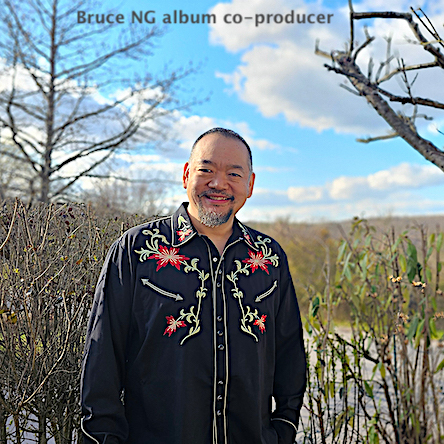
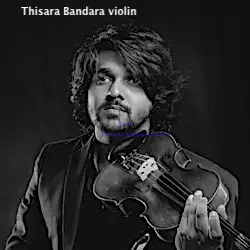
Even the title is something of a musical revelation with its allusions to the Indian percussion instrument known as the Mridangam, as well as the Handpan, an instrument that originated in Bern, and of course Rahul’s superbly performed electric guitar skills. The title track and other song titles are rich with references to Indian culture. From the country of Spain, Ruben Rubio excels on electric bass, while from South Africa, the artist known as Chaplin adds in tasty grand piano sounds. Various musicians from Poland, Colombia, Argentina, Turkey, France, South Africa, Sri Lanka, Spain, India, and the United States also contribute to the album’s impeccable and colorful musical palette. As with the 2017 album Ma De Re Sha, the new album was also tastefully co-produced by Bruce Ng. Mridhangit enters mysteriously with the appropriately titled “Mr. Sinister” with its strum and twang intro. The song has Indian music touches, but I would say it’s more prog instrumental. The layered electric guitars provide fascinating effects, giving the song a one-two punch. “Bheja Fry” is next with its Indian raga like introduction. When the Tabla comes in balancing Rahul’s guitar attack, you know you’re home. Rahul’s intrinsic balance of fusion and Indian music modalities comes into focus on this track. Unbelievably, “Twelve Ganeshas” takes the album into the sublime direction of smooth jazz ala giants like Larry Carlton and George Benson. The title itself pays homage to the Hindu deity Ganesha, known for his elephant head. Interestingly, the mood of the song is breezy and golden, hardly a trace of heavy jazz. Rahul delves deeply into progressive jazz fusion on album highlight “Enjoymaddi”. The jazzy drumming of Leo Margarit melds perfectly with Rahul’s guitars and the deft piano work of Chaplin. In fact, coupled with the upright bass work of Maciej S from Poland, the song features the intrinsic ESP inspired energy of the whole band. Prog fans and fusion fans will connect with “Enjoymaddi.” The title track “Mridhangit” features the stellar percussion and Konnakol vocals of Mridangam master Praveen Sparsh who paves the way for the band to enter with a pensive layered Indian style backdrop with the solid drums of Leo Margarit. “Kalli Penn” is almost Santana inspired from the days with organist Gregg Rolie. Those great times were blessed with great music and Rahul keeps the spirit of fusion’s roots alive on this high energy fun-filled romp that serves as a great focal point for the power of this lineup of musicians.
But clearly Rahul’s guitar attack is unique and very high energy in and of itself. High energy but equally accessible for all guitar fans. “Dushtan” is the single from the album. It’s high energy raga metal of sorts. The track also features the masterful violin player Thisara Bandara from Sri Lanka. Not only does the violin join the guitar for the powerful unison melody but it then takes flight for a standout solo performance. Rahul references mythology with “Rahu Ketu”. You can almost feel the urgency of Rahul’s guitar driven forward by this talented band. The guitar choruses are quite magisterial, giving the track an interplanetary glow. Interestingly, with its many musical moves “Rahu Ketu” is the longest track on the album. “Four Seas” is another fine showcase for pianist Chaplin, and percussionist Praveen. Sedate and elegant, the song brings forward some stellar guitar work from Rahul and the Mridangam of Praveen. The song picks up steam with Leo’s drumming balancing out the overall low-key intensity. “Mutabor” finally concludes the album. That track showcases some mournful Duduk playing before Rahul takes the album to a meditative closure with the Duduk, guitar and Tabla bidding the listener farewell in a sonic field of guitar delay and percussion. Almost elegiac in feeling, “Mutabor” achieves a mysterious fade out into the sunset. All in all, Mridhangit is among the finest examples of modern day South Asian style guitar-based instrumental fusion. A stunning follow-up to the multi-award winning Ma De Ra Sha, the 2026 offering by India’s rising guitar fusion ace Rahul Mukerji, Mridhangit is a spectacular guitar-fusion masterwork that crosses instrumental music borders with finesse.
mwe3.com presents the 2026 interview with
Rahul Mukerji: After Ma De Re Sha, I switched gears and expanded my portfolio into music scores for theater, podcasts, and film. I ventured into video production and editing and creating press kits and branding materials for musicians. Many of these projects earned me international and national recognition. Another highlight for me was performing at the renowned John F. Kennedy Center for the Performing Arts. I also focused on my visual arts by participating in exhibitions and creating visual backdrops for local artists. Mridhangit has benefitted from my work in other disciplines of audio engineering. My work in scoring theater and movies permeated the tracks in the album, and it’s evident in terms of space, arrangements, ambiance, and effects. mwe3:How did the album take shape and how did you assemble the band that accompanies you on Mridhangit? Tell us about the key players that back you on Mridhangit and how did you hit on the globalist approach and using a number of musicians from so many different countries. How was the album recorded, through the magic of the internet? It’s amazing how well it all fits together. In what ways was it challenging to record and what took longer, the writing of the music or the actual recording? Rahul Mukerji: Since the album was conceived during the pandemic, I took advantage of the online collaborative environment that was prevalent at the time and reached out to many musicians from around the globe. Being a fan of Pain of Salvation, I reached out to their drummer, Leo Margarit, through our mix engineer, Brett who connected us, to collaborate on this project. Praveen Sparsh was another key musician known for his genre-blending skills who I wanted on the album. As everyone was quarantined, we had to work on our sessions at our respective studios and send our tracks to each other. There was a lot of back and forth over the years. Running a project such as this remotely presented many challenges. Finding the right musicians, not from a technical fluency, but from a “fits the sound” perspective was difficult. The next challenge was arranging the pieces and giving each instrument its space in the mix. As with such projects, budgetary constraints and evolving artistic direction added to the complexity.
Rahul Mukerji: Thank you for your kind words on the music. I think people resonated with Ma De Re Sha for its melodies, songwriting, and for its fusion of instrumental rock and Indian elements, highlighting the blend of heavy guitar riffs with Tabla rhythms. Mridhangit expands on that by embracing improvisation and allowing the music to shape the structure. It retains the heavy guitar foundation while adding a variety of rhythmic instruments. It keeps a strong focus on melody while allowing for experimentation. I’ve known Bruce since 2006 when we were in a band together. Bruce has a broad taste in music and has a strong ear for subtleties and nuances. As we share a lot of similar influences, it’s easier to talk to him and convey ideas. His attention to detail leads to better quality and enriches the project. He’s able to help avoid the pitfalls of overindulgence and corrects parts that don’t serve the song. mwe3: Would you say the Indian music influences are more prevalent on Mridhangit compared to your other album? Also do you have a mentor? Rahul Mukerji: Yes, I would agree that Indian music influences are more prevalent on Mridhangit. It’s in the instrumentation and its approach to how the music is structured. I’m not a student of either Hindustani or Carnatic music so I don’t compose or play in any traditional manner. I do, however, borrow ideas and structures and implement them in my own way. It’s a great way to exercise creativity, explore new sounds, and break away from the standard progressions. With regard to studying under teachers, during the pandemic, I decided to formally seek mentorship and guidance so as to better myself. I studied under Steve Herberman, an acclaimed American jazz guitarist and educator, for two years. I’ve also been studying under Prasanna Ramaswamy, known as Guitar Prasanna, for about three years focusing on broad musicianship, improvisation, and theory. I’m thankful to both Steve and Prasanna, whose mentorship has greatly shaped my growth as a musician! mwe3: What guitars are you featuring on Mridhangit and has your choice of gear changed since you released Ma De Re Sha along with various pedals, amps, etc. Do you have a favored guitar effect or pedal, and can you give a couple examples of tracks on the new album with your favorite effects or guitar treatments?
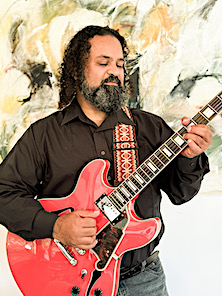
I’ve traded the half stack and a 5-foot pedalboard for a Kemper and it’s the best decision I’ve made. It works for my setup, I’m happy with my tone, and my back thanks me for it! My live gear is now a much simpler and lighter setup. My main guitar has remained pretty much the same: Suhr Modern M1. The album does feature a Brian Moore i9 guitar, Charvel San Dimas, Fender Stratocaster, Jericho Baritone 7-String, and a Jackson Dinky 7 String guitar. When I record, I use Neural DSP and my old Amplitube2 plugins. However, I got my guitar tracks re-amped at the studio through EVH 5150 III Stealth 100W head and PRS Archon. Guitar effects wise, my time spent composing music scores for film led me down to exploring reversed delays and they feature in songs like Mutabor and others where they serve as lovely ethereal artifacts to the soundscape. Additionally, I love a harmonizer pedal on the lead guitar, and that is featured on “Mr. Sinister”. mwe3: Some of the song titles on Mridhangit have references to historic Indian archetypes. Some of the more obvious titles include “Twelve Ganeshas” and even “Rahu Ketu”, two minor planets that work with the other personal inner planets like Venus, Mars and Mercury. I was particularly impressed by “Twelve Ganeshas”, which is so upbeat, and signifies new beginnings. Also, Rahu and Ketu are interesting concepts used in astrology that have roots in mythology. How did the naming of that track come about?
I decided to count how many of them were present in my room and there were twelve. It was also coincidental that it was the twelfth month of the year. Ganesha is also seen as the deity of new beginnings. And as the composition was being written at the end of the year, moving into the new, I thought the title “Twelve Ganeshas” was quite apt! The track “Rahu Ketu” was titled well after the composition was created. I was reminiscing about my childhood and mythology comics and the story of Rahu Ketu always stood out to me as a great one. There is a fascinating backstory of demons and gods working together and the treachery and deception from both sides. Anyhow, it results with the Sun and Moon gods exposing the demon who had started to drink the nectar of immortality, the punishment for the same, the wrath of the fallen demon, and the birth of Rahu and Ketu from that event. This story was also used to explain the solar and lunar eclipses. The song fits that narrative in my head really well, as it traverses some calm and chaotic sections reflecting main themes from the story. I really like the ending section which has guitar slides under the whammy bar heavy outro section, while the song crescendos into chaos. It vividly painted the eternal chase of Rahu’s desire to swallow the sun, in my head. So, I named it after one of my favorite childhood stories. mwe3: “Enjoymaddi” is directly related to the Kannada language spoken in Southern India. Also, the track features the amazing acoustic piano of the South African pianist Chaplin. Who is Chaplin, how did you meet her, and would you say the track is a definite focal point of the album? Leo Margarit’s drumming is excellent too. Did you record the track in the studio with the musicians or was it all done, like so much music, through the internet files? How does the warmth you spoke about come through on this track? It’s certainly heartfelt sounding. Did you use an altered spelling for “Enjoymaddi”?
I was very lucky to have her play on my tracks, and she has greatly enriched them with her performance. I found her profile online when searching for keyboard and piano players during the pandemic. Her style, interpretation of my compositions, and improvisation over them added a whole new dimension. In fact, after incorporating her tracks, I revisited the arrangements and structures of certain pieces! The framework I provided to Chaplin helped elicit certain colors or moods in the music. She had mentioned this was one of the most interesting projects she had worked on because of the restraints and complexity of the framework. I had conveyed the kind of emotion and atmosphere I was looking to have in the finished piece. She was able to take that direction and deliver music with great emotional depth. The warmth one feels on this track is based on her interpretation and then how the track comes together with the contribution of others. The upright bass being bowed and plucked, by Maciej S, on Enjoymaddi absolutely adds to the warmth. Everything on the album was done remotely due to the quarantine. If I had the opportunity to have a studio session with these musicians, I think we would have a lot of wonderfully improvised pieces! But it would have been a very different album, sonically. The song serves as a tribute to a friend which is reflected in the adjusted spelling of the title, for personalization! mwe3: The title track “Mridhangit” is a great showcase for the album’s star percussionist Praveen. Tell us about Praveen Sparsh, how you met him and is he also adding vocals in addition to the Mridangam? How would you describe the sounds of the Mridangam and the Handpan, and the sounds they create in contrast to the way they support your guitar. Also, that track has flute too? Tell us about the musicians on that track. Leo’s drumming keeps the sound firmly in the fusion realm, yet there’s much more going on.
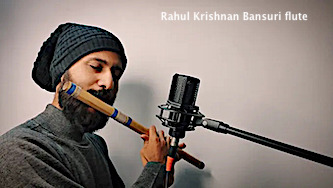
As a track, “Mridhangit” exemplifies what the album is about: exploring different disciplines to create a cohesive piece of work. Mridhangit features Carnatic and Hindustani musical elements: Konnakol, Mridangam, Tabla and Bansuri. This presents a little bit of the interplay between northern and southern styles. This coupled with western harmony and instruments really showcases the variegated nature of the collaboration. The Handpan is, to me, the glue that keeps the track together through all the changes. It is a wonderful percussive and melodic instrument that lends itself to meditative environments. It is intentionally a little understated in the track, and counters the sharper percussive nature of the Mridangam and the Tabla that comes in later. The challenge for us and the mix engineer Brett was to help best separate the instruments into their own space in the stereo field. Rahul Krishnan, from India, plays the Tablas and the Bansuri (Indian flute) on this track. I love the solo he crafted for this section, and it closes out the song beautifully with its hypnotic repeated melody. His contribution to the track was a perfect fit with respect to playing style and arrangement. The musicians on the track are: mwe3: I describe “Kalli Penn” as sounding influenced by Santana. Did you feel that exotic, carnal vibe on that track? There’s even an organ playing on the track. Your guitar work is on fire on “Kalli Penn”. Tell us about the guitars and guitar sounds on that track? You say that “Kalli Penn” and the track “Dushtan” are related. Can you elaborate a bit more? “Kalli Penn” is almost lighthearted in framework while “Dushtan” is almost like Black Sabbath! Tell us about the Indian music influences on “Dushtan.”
While experimenting, I found that the organ worked really well and it did impart a Santana vibe. Chaplin is on the keys on this song. I embraced the sound by pulling in some percussion as well. So, the “vibe” came about by accident. Thank you for the kind words on the guitar work on this song. I was having a lot of fun with the phrasing and lines. I liked the fact that the instruments phrased in unison at the 1:56 mark. It’s a very playful and upbeat track. Gear wise, this one used just the Suhr Modern M1. And the tones were reamped as previously mentioned. Very simple setup for this song, from a guitar perspective! Kalli Penn and Dushtan are related. When I was younger, I worked in a corporation where we had a lot of friendly banter among colleagues. Being young and reckless, I was always a little mischievous and was given the moniker, “Dushtan”, in a playful manner. Dushtan can mean “rogue”, “mischievous” depending on context. In turn, I called my friend “Kalli Penn” which means “mischievous girl”. It’s a lot like the 90’s office sitcoms where you have young working professionals and each has a nickname. In that sense, this song captures that time in my life in a fond manner. When it came to naming the tracks, I titled the lighter and upbeat track “Kalli Penn” to reflect my colleague’s personality. I titled the heavier piece “Dushtan” as it is a better reflection of my personality back in the day. While Kalli Penn evokes Santana vibes: upbeat, light, and buoyant; Dushtan embodies a darker atmosphere. I was playing around with my loops when I came by the Dhol (North Indian percussion instrument used a lot in Punjabi and Gujarati music) samples and loops. So, I programmed a few sequences and started to riff over it. The tonality I landed on was Phrygian, which really helps with the darker mood. The ending line of the main riff has a descending pattern, and I really wanted to have someone harmonize that with glissando/slides. I thought it would be interesting to try and channel my Mahavishnu Orchestra influences and bring in a South Indian violin on that. And that is how I went looking for a violin player to play on the track. Solo wise, I’m really squeezing blood out of that whammy bar! I have been trying to understand and emulate Jeff Beck’s phrasing, and it led me to come up with some whammy lines that sound like slides. The violin player had complete freedom to do what they wanted, within the framework provided, and this was their first submitted take on the solo! It sounded great, so I kept it.
Rahul Mukerji: Ha! Leo is fantastic and just the greatest and nicest person to work with. I’m so grateful to have him on the album. And I don’t have any thunder he can steal. He’s from one of the best progressive bands ever. And yeah, this is one of those songs that you just come up with a name as soon as the A-Section takes form. It was so energetic and lip-smacking good, I immediately thought of pakora and then added “funky” to it. Yeah, it’s got some tasty lines on it from all the players, spicy and zesty! I thought the name was a great fit. My favorite pakora, at the time of writing, has to be ‘Bread Pakora’. I haven’t had one in years, and it was a staple in my college years with the tangy and spicy chutneys. I also love onion, potato, and chili pakoras. Ok, now you have me craving pakoras! The Clarinet player added some great harmony to the main theme and has a great solo. It really adds a great contrast to my solo. It was a bit of a gamble using a Clarinet player as I didn’t know how the final track would sound, but it’s worked out so well. Rafael plays the bass on this track, and his solo is just outstanding. Yes, this might be my smooth funk jazz track of the album. mwe3: “Four Seas” you say is based on C chord inversions and you compare it to the ocean. Tell us something more about “Four Seas”. It’s also a good showcase for Praveen, right? Might be my favorite track on the album. Can you say something about “Four Seas”?
Chaplin’s soundscape is just otherworldly! Ruben’s fretless bass adds a whole new dimension, while Leo’s drum work anchors the track. There is great balance between the musicians and it’s a great showcase of how powerful musical collaborations can be when artists are given creative freedom. From a naming perspective, since I was working in the key of C, I chose “4 C’s” as the working title. When it came to finalizing the titles for the release, I went with “Four Seas” as Chaplin’s piano sounds open and full of waves and has this calming effect through the track. It reminds me of water whenever I listen to it, so “sea” came to me quite naturally. On a side note, the new name is also less nerdy. mwe3: The album closes with a mournful track called “Mutabor”. How did you find a connection to German folklore? Tell us who is playing with you on that track. It sounds like your guitar, and who is on Duduk? Your guitar sounds meditative too. What was your guitar approach on “Mutabor”? It’s almost New Age in nature. Does “Mutabor” shine a light on another side of your music? I think new age radio would play this track. Or is it world music?
Mutabor was carried in one of the Tinkle Comic issues. I recall reading this story of Mutabor and it stuck with me partly because there’s mention of an Indian princess who helped the storks. Anyhow, as I grew older, I kept looking up that story and the meaning really evolved for me. What was a very odd and interesting story, has really become an introspection piece for me as it talks to humility, respect, deception, and life. And it takes me down a journey of self-reflection. This song mirrors that emotion by using the emotive Armenian reed instrument – Duduk. This instrument is used a lot in cinema for its haunting tone. My work with the theater and film scoring introduced me to new sounds, and other facets of music production. I was able to find a Duduk player named Erkan Erginci, from Turkey, and had him on the track. From a guitar perspective, I was playing around with some large interval open string arpeggios and found a sequence that really caught my ear. I kept exploring it and before I knew it, I had a very meditative piece in 7/4. Once I had this framework, I sent it to Erkan and provided some guidance around it. Sure, the piece can fall into any set of categories and that is a nice feature. It can fit nicely in meditation circles, new age music, sound therapy sessions, and whatever platform can use it. If it ends up helping people, that is such a beautiful thing! I don’t particularly care what it’s categorized as, if it can resonate with someone, regardless of settings and musical preferences. mwe3: Tell us about the album cover art. How did you create it? How active role did you take on the album artwork / layout? Who did the mixing and mastering and who else helped you on the album?
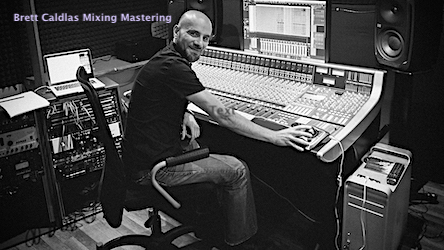
While looking for an album cover, my partner Shawna suggested I use my fractal art as the album cover. After trying out a few different pieces, we landed on this one, as it does look like the decorated side of a Mridangam, it has bright colors and is a great fit for the album title: Mridhangit. I take a very active approach in my album cover artwork and layout as I’m the one doing it. I had created over a hundred and twenty covers for Ma De Re Sha and had about forty options for this album. I do like having my visual art incorporated into my musical art. Sometimes I create scores for my fractal videos, sometimes the fractal images serve as an album art for some tracks. Synergy! Speaking of synergy, for mixing and mastering Bruce and I returned to Brett Caldas-Lima at Tower Studio in France. His work on my debut was amazing, and we wanted to preserve that sonic character. Brett’s vast experience with fusion music allows him to understand my sound and highlight each instrument effectively in the mix. He’s done such a marvelous job on this album, and it sounds great because of his time and effort. mwe3: What have you planned for the future? Tell us album release timings, videos, anything year of the horse. Writing, recording, producing, other interesting things you are involved in now or coming up? Rahul Mukerji: I have several EPs planned for the coming years, which I'll release depending on how Mridhangit performs. Meanwhile, I'll keep working on other music projects and hope to eventually integrate my various art forms into one cohesive work, though its final form is still uncertain.
IN HIS OWN WORDS RAHUL MUKERJI GOES TRACK BY TRACK ON MRIDHANGIT
Twelve Ganeshas - This one is inspired by the Hindu deity of new beginnings. The music reflects quiet reverence and creative rebirth—an invocation for fresh journeys ahead. I really like the groove on that one! The title is a literal reflection of a moment, while on vacation in India, I counted Twelve Ganesha idols in my bedroom. Photographs of Rahul Mukerji used by kind permission of Shawna Adora
|
|
|||
|
||||

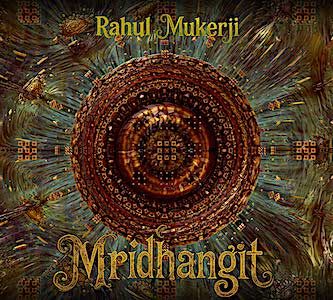 Guitarist and composer Rahul Mukerji strikes instrumental jazz fusion gold with his 2026 album Mridhangit. An impressive follow up to Rahul’s critically acclaimed 2017 release Ma De Re Sha, the new release is described as A Collaborative Album by Rahul Mukerji. A collaborative effort in the finest sense of the word, Mridhangit finds the guitarist in the company of some excellent backing musicians.
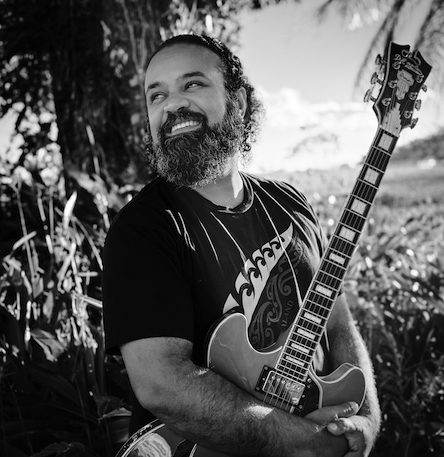 Rahul cites John McLaughlin’s Mahavishnu Orchestra as an influence on his guitar playing and compositional styles, while another influence that comes to light on certain tracks here is Carlos Santana. There’s an abundance of hard rock instrumental styles driven by the powerhouse drumming of Leo Margarit while other instrumentalists featured include the string driven sound of violin master Thisara Bandara.
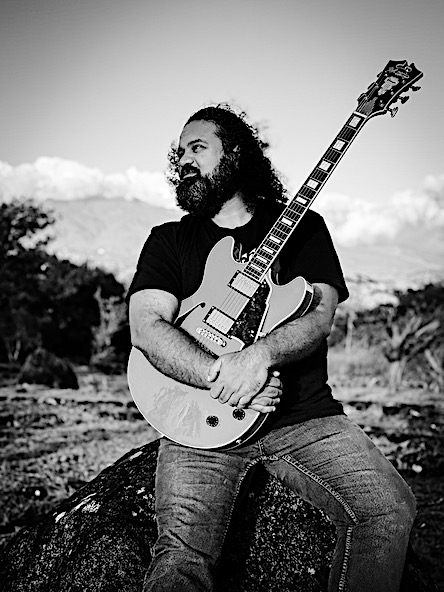 “Funky Pakora” continues the fun energy of “Kalli Penn” and sounds inspired by the 1970s era fusion of Al DiMeola and Sweden’s Janne Schaffer to name a couple.
 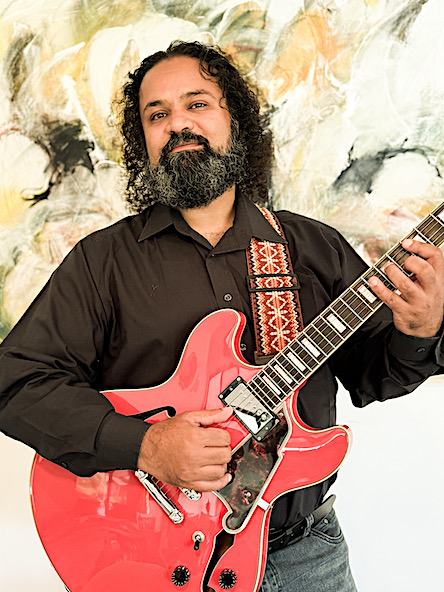 mwe3: It’s been a while since you released Ma De Re Sha in 2017. What have you been up to these last recent years and why did it take so long to release what is now your 2026 album Mridhangit?
  mwe3: In what ways is Mridhangit similar and yet different from your previous album Ma De Re Sha? It does seem like your music has gone to an even higher level! Sounds that way to me!I know you have the same producer Bruce Ng returning on Mridhangit. What did Bruce bring to the new album and how did you meet him? How did you meet up with Bruce and what does he bring to the table during the recordings?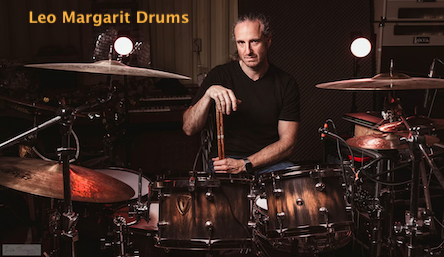
 Rahul Mukerji: The album certainly has references to Indian culture, vernacular, and mythology. The tracks “Twelve Ganeshas” and “Rahu Ketu” are prime examples. I was visiting India in December of 2023 and at home, we have quite the collection of Ganesha statues.
 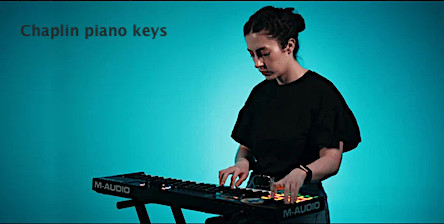 Rahul Mukerji: The South African piano and keyboard player goes by her artist moniker “Chaplin” and is another one of the key artists featured on the album. Her work is exceptional, but the tracks “Enjoymaddi” and “Four Seas” stand out as major highlights on the album.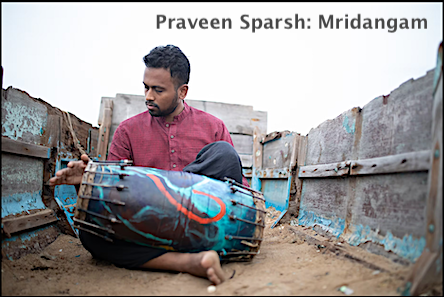
 Rahul Mukerji: Everyone’s been saying that about that track! It was not intentional at all. When I composed the track, I didn’t think of it having an underlying organ and percussion. However, when the scratch track was done, it felt incomplete.
  mwe3: “Funky Pakora” everybody loves Pakora. Indian food is now the number one global food, right? Sometimes they even have sitar players playing for customers in the restaurants. Is this track kind of like Indian food? Happy and spicy! What is your favorite pakora? Also, another track with Clarinet and the bass solo is great. Leo nearly steals your thunder! Is this the smooth / funky jazz track on the album? lol but it’s still great.
 Rahul Mukerji: I was playing with inversions, when I came upon this sequence. I decided to use it as a bed for others to improvise over and really explore the sound. Praveen is just a master at his instrument and shines on this track.
  Rahul Mukerji: Back in the 1980s and 1990s there were these famous Indian comics called Tinkle Comics and Amar Chitra Katha. If memory serves the Rahu Ketu story was published through Amar Chitra Katha.
 Rahul Mukerji: I am also a visual artist and one of the mediums I use is digital fractal art using Mandelbulb3D. It’s free software and a fun one to use. I’d created a lot of fractals back in the early 2010s, and one of them was titled “Eye of the Storm” which was rendered in August 2013.
  Mr. Sinister - For me this track unfolds like a ritual gone wrong. A slow-burning descent from reverence into ruin. It begins as meditative devotion & slowly mutates into violent dissonance. The track serves as a metaphor for the predator/charlatans, who we see so much of—those who use the guise of peace to lure the vulnerable before descending into chaos. The calm is calculated, the chaos inevitable. More recently, I’ve found that it reminds me of the manipulative energy of figures like Vecna from "Stranger Things"!
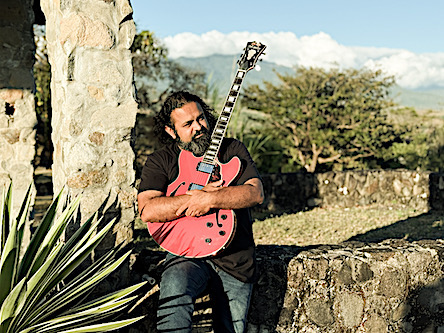 Kalli Penn / Dushtan - These sister tracks find their roots in office banter! Dushtan (the rogue) and Kalli Penn (the mischievous girl) are lighthearted, playful compositions that capture the energy of office life. While “Kalli Penn” captures that spirit—warm, teasing, and carefree, “Dushtan” provides the counter-narrative, together forming a nostalgic portrait of workplace camaraderie.